




ORGANS OF PARIS © 2026 Vincent Hildebrandt HOME ALL ORGANS



This church is one of the oldest in Paris. Built on the
site of a Roman temple and a Merovingian church
dating from the 7th century, it was consecrated in
1147. Four black marble columns (two against the
west wall, one at the entrance to the apse, and one
in the north aisle) come from the original
Merovingian building.
The church is a fine example of the transitional
period between Romanesque and early Gothic
architecture. The choir features one of the first
ribbed vaults in Paris (around 1147). The façade
dates from the 17th century, and the bronze doors
were made in 1980 by T. Gismondi.
In the 1670s and early 1680s, music played an
important role in the abbey’s religious life. Marc-
Antoine Charpentier wrote devotional works to be
performed there.
During the Revolution, the Abbey of Montmartre
was destroyed and the church, looted, was turned
into a Temple of Reason. It was restored between
1899 and 1905 by the architect Sauvagot, and
returned to worship in 1908.
Since 1953, the church has been adorned with the
magnificent stained-glass window by Max Ingrand.

C1
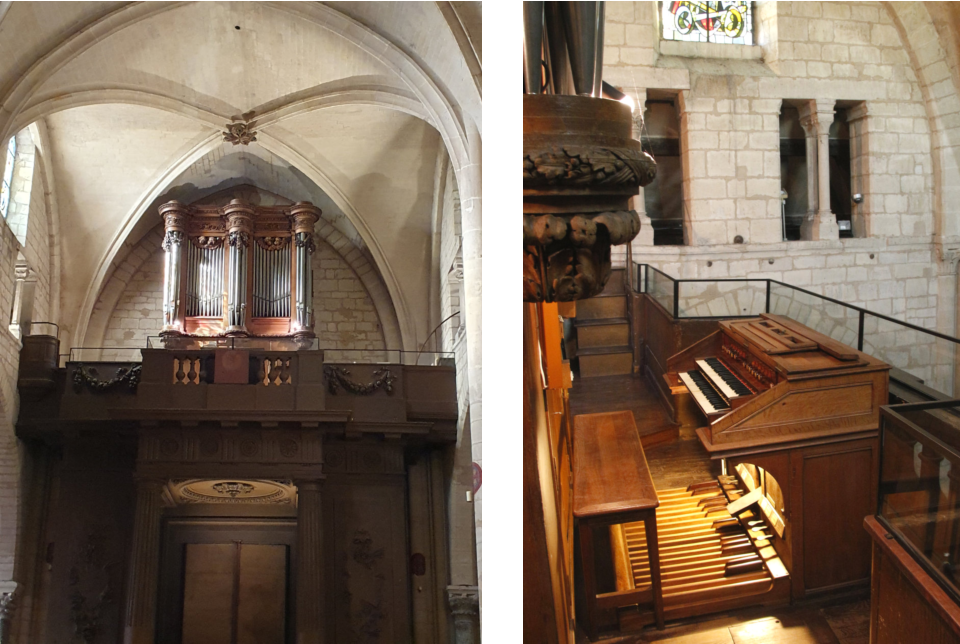
There was already an organ in the church at the end of the
18th century, but it disappeared during the French Revolution.
The current organ case comes from the former Notre-Dame-
de-Lorette (destroyed during the Revolution) or possibly from
Saint-Pierre-des-Arcis, and dates from the late 18th century.
Around 1820, the organ was installed at Saint-Pierre de
Montmartre. Its builder and original specification remain
unknown.
In 1868–1869, Cavaillé-Coll built a new instrument, reusing the
old case.
At an unspecified date, Mutin added a 16’ Soubasse and a
Plein Jeu (with pneumatic action), and also modified the
console.
In 1960, the instrument was restored by the Beuchet company
(Picaud), who replaced the Plein Jeu.
In 1991, it was cleaned and overhauled by Sebire & Glandaz.
In 2018–2019, the organ was restored by the Plet firm of
Troyes, with the addition of an 8’ Bass stop on the Pedal as an
extension of the 16’.


Buffet 18th
1820 - ?? (7)
1869 - Cavaillé-Coll (8)
19xx - Mutin (2)
1960 - Picaud (5)
1991 - Sebire & Glandaz (6)
2019 - Laurent & Pierre-Adrien Plet (5)
II/13 (12) - mechanical traction
Stoplist









The organs of Paris


ORGANS OF PARIS © 2026 Vincent Hildebrandt


Buffet 18th
1820 - ?? (7)
1869 - Cavaillé-Coll (8)
19xx - Mutin (2)
1960 - Picaud (5)
1991 - Sebire & Glandaz (6)
2019 - Laurent & Pierre-Adrien Plet (5)
II/13 (12) - mechanical traction
Stoplist
C1
There was already an organ in the church at the end of the
18th century, but it disappeared during the French
Revolution.
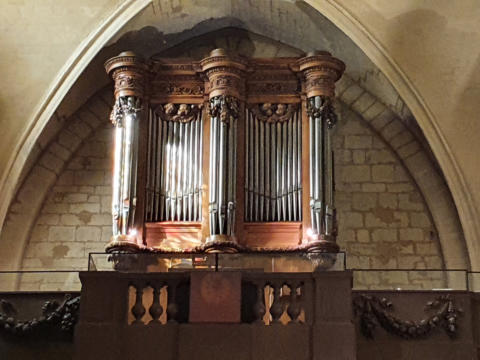
The current organ case comes from the former Notre-Dame-
de-Lorette (destroyed during the Revolution) or possibly from
Saint-Pierre-des-Arcis, and dates from the late 18th century.
Around 1820, the organ was installed at Saint-Pierre de
Montmartre. Its builder and original specification remain
unknown.
In 1868–1869, Cavaillé-Coll built a new instrument, reusing
the old case.
At an unspecified date, Mutin added a 16’ Soubasse and a
Plein Jeu (with pneumatic action), and also modified the
console.
In 1960, the instrument was restored by the Beuchet
company (Picaud), who replaced the Plein Jeu.
In 1991, it was cleaned and overhauled by Sebire & Glandaz.
In 2018–2019, the organ was restored by the Plet firm of
Troyes, with the addition of an 8’ Bass stop on the Pedal as an
extension of the 16’.

Buffet 18th
1820 - ?? (7)
1869 - Cavaillé-Coll (8)
19xx - Mutin (2)
1960 - Picaud (5)
1991 - Sebire & Glandaz (6)
2019 - Laurent & Pierre-Adrien Plet (5)
II/13 (12) - mechanical traction
Stoplist
